
Loosely defined, misinformation is false information, no matter whether the creator or sharer of that information intended to mislead or not.
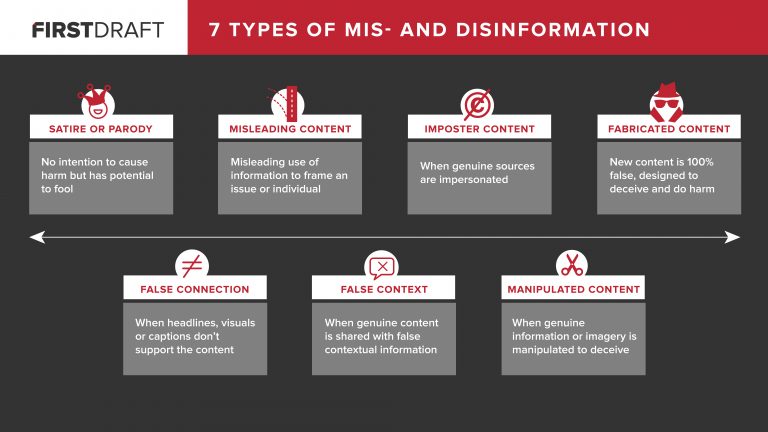
"7 Types of Mis- and Disinformation" by First Draft is licensed under CC BY 4.0 DEED.
Misinformation and disinformation have a lot in common:
"7 Types of Mis- and Disinformation" by First Draft is licensed under CC BY 4.0 DEED.
The biggest difference between misinformation and disinformation can be seen in the intent: while misinformation is distributed without intent to confuse or mislead, disinformation is spread with knowledge of its incorrectness and intention. First Draft's infographic offers several possible reasons for disinformation including provocation, political motivation, financial gain, or propaganda.
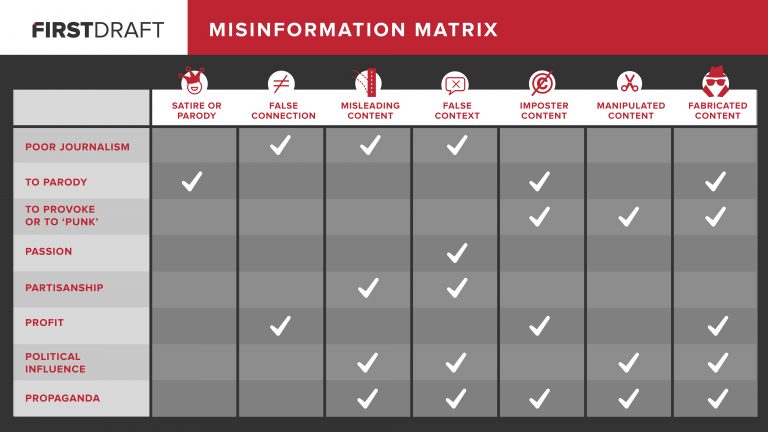
"Misinformation Matrix" by First Draft is licensed under CC BY 4.0 DEED.
Considering the general difficulties with fact-checking and information verification online, the introduction of artificial intelligence (AI) software such as Chat GPT adds an additional complication. AI generates text and images online based on its programming. Due to either coding flaws or bad actors, some of this content (but not all) contains misinformation and disinformation. Because computers and AI naturally are able to generate output faster than humans, even some misinformation can still represent a lot of content. Naturally, this makes information consumers nervous about a viral spread of AI-generated misinformation and disinformation, and with good reason.
The good news is that the same principles for information verification work to combat misinformation produced by artificial intelligence as misinformation created by humans.
If you are interested in digging into this complex topic in more depth, consider these resources:
Clickbait is a disinformation technique where an online link (often accompanied by an image) makes a claim so outrageous that a user's curiosity is provoked to click on it. This is used on websites that use a "pay per click" advertising scheme.
Source: “This one weird trick will help you spot clickbait” by TED: “Health headlines are published every day, sometimes making opposite claims from each other. There can be a disconnect between broad, attention-grabbing headlines and the often specific, incremental results of the medical research they cover. So how can you avoid being misled by grabby headlines? Jeff Leek and Lucy McGowan explain how to read past the clickbait.” [Directed by Zedem Media, narrated by Addison Anderson]. (description from the TED website)
Images can evoke powerful emotions without any words. These days, computer users can create, alter, and share images and video fairly easily. Users can program artificial intelligence (AI) to create images based on certain parameters such as a style of art, film, or photography. As a savvy searcher, there are often ways you can tell whether an image or video you see online is an original photograph captured from real life or if it has been changed. The tutorials below may help you to determine the differences just by close observation and by using online tools to locate source material.
Many people consider the phrase fake news to be outdated. This is because the term has been used often in order to politically belittle the arguments of others. However, because it still is used in some contexts, we will include and discuss the term here.
As with so many terms surrounding mis- and disinformation, it is hard to find a universally-accepted definition of fake news, but there are some characteristics that all fake news generally has:
(For definitions, see Some Key Terms for the Savvy Searcher on this page.)
Why should you care about whether or not your news is real or fake?